
In the second part of my blog post I will talk about the practical implications of my master thesis.
Practical Implications of AI Integration in Business
Through the interviews with industry experts, main emphasis on artificial intelligence (AI) adoption was the importance of starting small. By focusing on practical examples, companies can analyze their internal processes and identify AI tools that align with specific stages of product development. This strategic approach ensures that AI adoption is not merely a reaction to industry trends but a thoughtful response to real challenges.
Strategic Adoption Over Competitive Pressure
AI should be adopted with a clear purpose, addressing genuine problems rather than being driven by competitiveness or external pressures such as competitor actions. Companies must also be mindful of employee experiences, minimizing frustration that can arise from poorly integrated AI tools. Setting clear objectives is essential to foster enthusiasm and support for AI initiatives.
Empowering Early Adopters
The human element plays a crucial role in successful AI integration. Encouraging early adopters to experiment and develop technical expertise within the organization is vital. Providing comprehensive training on safe and compliant AI usage is equally important, especially in managing risks such as data misuse and building trust in AI tools.
Defining a Clear Strategy
A key takeaway from my research is the necessity of defining a company’s strategy regarding the AI adoption process. Organizations should empower early adopters, leveraging their enthusiasm and voluntary participation to facilitate the transition and build internal knowledge. Feedback from these pioneers, combined with targeted training, can help adjust strategic positioning, enhancing enthusiasm while alleviating frustration.
Addressing Barriers to Entry
In addition to focusing on people, companies must consider barriers to entry, such as data security concerns and the availability of infrastructural resources. Small and medium-sized enterprises, in particular, may struggle with the resources needed to train their own AI models. For these businesses, regularly analyzing the market for existing AI tools and technological advancements is crucial to maintaining competitiveness.
Utilizing Data for Strategic Insights
As I showcased in my previous post, the findings of my research can serve as a foundation for further analysis. These insights can support strategic positioning and decision-making. For instance, as seen in Figure 1. a SWOT analysis can help companies identify strengths, such as increased efficiency and the benefits of integrated AI tools. Recognizing weaknesses, like resource limitations or inadequate training, highlights areas that require investment in infrastructure and skill development.
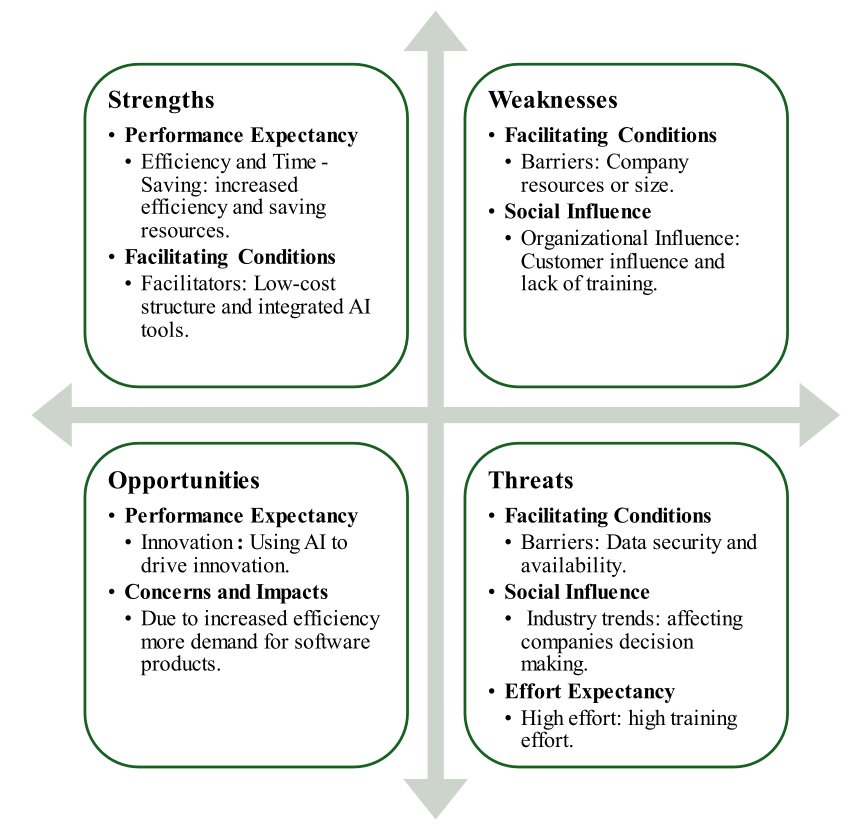
Opportunities for innovation and the growing demand for new software products can motivate businesses to leverage AI to enhance development speed and strengthen their competitive edge. However, companies must also navigate threats, including data security issues, shifting market trends, and high training demands. Efficient planning, strategic alignment, and robust risk management are essential to overcoming these challenges and ensuring successful AI integration.
In the next post I will be introducing you to AI augmented new software product development framework.
Sources:
Arman, M. N. (2025) ‘Join New Software Product Development with Artificial Intelligence: Investigation of Useful Factors of AI Integration in Software Development’
 nevzatarman
Leave a comment